So, because people writing inaccurate kid!fic bothers me, a quick reference to kids (Disclaimer: I have no professional background in child development, and no offspring of my own – this is all based on other people’s kids.):
Newborn: Person-larva. Cannot do much but eat, sleep, cuddle, cry, poop. Cannot hold their own head up. May pick up on the mood of the person holding them, but response to it is going to consists of either contentment or complaining. Those are pretty much the two states of a newborn: happily cuddly or expressing displeasure.
2 – 6 months: Somewhat more aware of surroundings, own appendages, etc. Will recognize people, like some better than others. Smiles, laughs, babbles. Somewhere in here rolling over commences, and possibly crawling. Starts teething.
6 -12 months: Lots of babbling, but no actual talking. Crawls, pulls self up to standing while holding onto things, may start wobbly independent walking. Some kids are climbers (may heaven help their parents). Eating some solid food (as in, mashed up stuff), but still nursing / drinking formula too. This is the beginning of the exploratory, everything-goes-in-the-mouth stage. Still teething.
1 year old: Has teeth, eats solid food. Many parents wean at this age, but it’s not unusual to continue breastfeeding. Talks, but probably not very clearly – pronunciation will be interesting, and vocabulary very limited. May repeat a new word incessantly. Points at things they want. Physical coordination and verbal skills increase as child gets older. Maybe develop utterly random phobias, usually of things that are new or unpredictable. Interested in other children, may mimic older children. Still sticks everything in their mouth.
2 years old: Speaks well enough to be understood by those who know them, but not necessarily strangers. Uses simple phrases. May mash words together to express a concept for which they don’t yet know the word, or make a word up. Is learning labels for things, though they may not be accurate (i.e. all old men are grandpa, all round objects are a ball, etc.) Knows colors, parts of the body, types of animals, etc. Walks, runs, dances, etc – basically the full range of physical stuff, just all of it is kinda awkward. Can roll a ball or throw it in a clumsy way. May have a favorite toy, security blanket, etc. May play pretend games or make up stories, but they’re likely to be fair inscrutable to adults. Wants to do things independently, but is likely to be easily frustrated. Has tantrums. Plays with other children, but not terribly good at sharing or being nice. Asks questions; the ‘why?’ stage has begun. Toilet training begins around this age; girls tend to get the hang of it quicker than boys.
3 years old – pretty much the same as 2, only a bit better at all of it. Asks a LOT of questions. Has friends. Plays pretend. Understands rules (though is unlikely to obey them very well). Can count, though not very far. Speaks well enough to be understood by strangers; you know that so-cute-you-could-die kid-speak people love to write? This is the appropriate age for it (up through about age 5).
4 to 5 – cutesy kid-speak is age appropriate. May still have tantrums, still not the best at sharing, but should be starting to get socially functional. Can throw or kick a ball, jump, stand on one foot, all that. Can count, recite alphabet. Some kids start learning to read and write arond this age, though it wouldn’t yet be abnormal for them not to be able to. Lots of pretend play. Emotionally intense; everything is dire. Learning to be self-maintaining, i.e. may bathe independently but needs an adult to wash their hair.
6 – 10 – speaks like an emotionally immature adult; the things they have to say are still kid-like, but they should be easing out of kid-speak. Reads, writes, can do math – these skills increase with age. Understands and (usually) obeys rules, has a concept of fairness, kindness vs. cruelty, etc. Forms tight friendships, keeps secrets, wants to fit in and be liked; having a best friend or a group of friends is the most important thing in their world. Wants to be good at things; has definite interests and academic strengths and weaknesses. May bully or be bullied; kids this age can be mean. As in horrifyingly so. Has crushes (though probably still finds it acutely embarrassing). Understands death. Kids this age will curse, though hilariously badly. Still wants parental affection, but probably not in public.
11 – 12 – mini-teen, which is to say emotionally vulnerable, short-sighted mini-adult. Naive still, but not terribly so – has a basic understanding of human nature, events around them, etc. Begins to form political / ideological / religious opinions. May begin reciprocal romantic attachments. Strongly focused on collective identity, what ‘niche’ or ‘crowd’ they identify with. Some girls start puberty. This is also the age of things going badly wrong; kids know which other kids are the sociopaths at this stage. While everybody else is learning how to not be a mean little shit to everybody unlike themselves (or a bitter perpetual victim), those few who aren’t developing in a good direction become downright terrifying.
13 – 15 – somewhere in here, kids will start either facing major adult-scale decisions and problems themselves, or seeing peers doing so. Shit gets real. This is why teenagers think they know everything; the rose-colored glasses of childhood fall off, and they are suddenly So Very Jaded and cannot imagine there being more to the world than what they can suddenly perceive now, because it is overwhelming. Likely to be angry at the world, likely to gravitate toward ideological extremes. Takes risks. Forms romantic attachments; may experiment sexually, may not, maturity levels here very A LOT.
16 – 21 – moody adult with far more curiosity than common sense. Does thing in grand and dramatic fashion. Experiments with different identities. Wants total independence. Many develop greater social maturity around this time; stop seeing others in terms of cliques, develop greater empathy and ability to see things from multiple perspectives. Forms romantic attachments that may be serious or even life-long.
This is pretty accurate IME, and if you want more detail for the first few years, try Touchpoints.
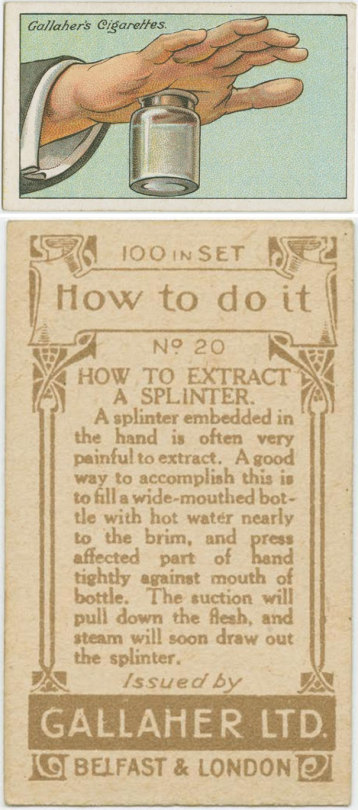
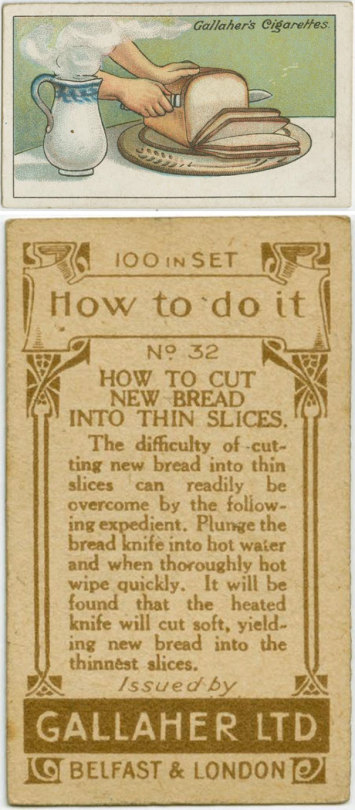
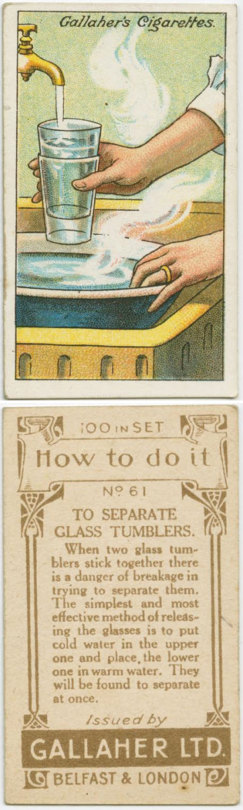
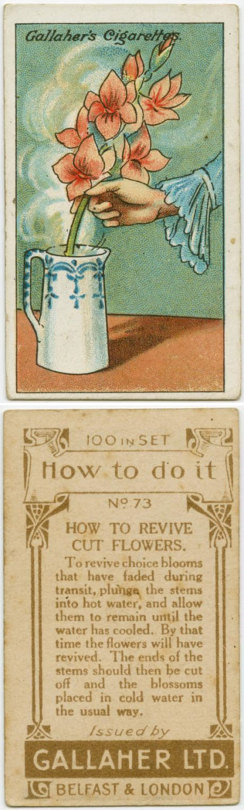
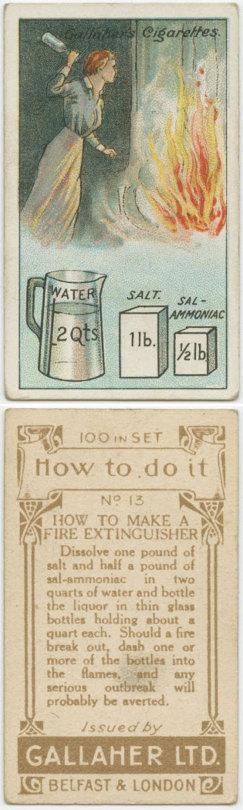
People don’t often look back on the early 1900’s for advice, but what if we could actually learn something from the Lost Generation? The New York Public Library has digitized 100 “how to do it” cards found in cigarette boxes over 100 years ago, and the tips they give are so practical that millennials reading this might want to take notes.
Back in the day, cigarette cards were popular collectibles included in every pack, and displayed photos of celebrities, advertisements, and more. Gallaher cigarettes, a UK-founded tobacco company that was once the largest in the world, decided to print a series of helpful how-to’s on their cards, which ranged from mundane tasks (boiling potatoes) to unlikely scenarios (stopping a runaway horse). Most of them are insanely clever, though, like how to make a fire extinguisher at home. Who even knew you could do that?
The entire set of life hacks is now part of the NYPL’s George Arents Collection. Check out some of the cleverest ones we could find below. You never know when you’ll have to clean real lace!
This site is supposed to help look into ballot initiatives.
ALSO – lots of public libraries offer voter information sessions and resources about elections, ballot initiatives, etc. so if you have the time to spare, I recommend checking them out.
if I remember correctly this was specifically addressing Aspergers, as George had just made a friend who had it, and the “thing” that he focused on and studied was trains
For those interested, Carl (George’s friend) shows up in several other episodes. He’s also interested in spaceships and rockets.
A new report by Ontario’s environmental watchdog has some strong words for successive provincial governments over the better part of the last half-century related to ongoing mercury poisoning at two First Nations in the northwestern part of the province.
The 2017 environmental protection report by Dianne Saxe, Ontario’s Environmental Commissioner was issued on Tuesday. Part of the document chronicles the history and current state of the historic pollution of the English-Wabigoon River system and its effects on Grassy Narrows and Wabaseemoong First Nations.
Speaking to reporters in Toronto during the release of the report, Saxe called the issue “shameful.”
“Both governments and business have long turned a blind eye to pollution of Indigenous communities,” she said.
The report itself was no less harsh.
“After accepting financial responsibility for the mercury contamination, the Ontario government declined to take action for decades, largely ignoring the suffering of the Grassy Narrows First Nation and Wabaseemoong peoples,” it stated, referring to a settlement reached in the mid-1980s between Ontario, the pulp mill and the First Nations.
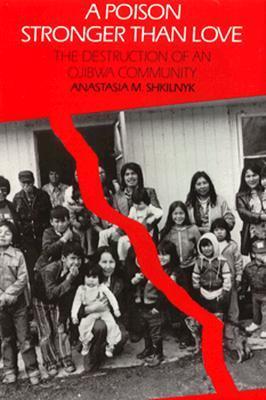
If you wanna read an excellent history about this whole goddamn shitty racist mess, read Anastasia M. Shkilnyk’s incredible A Poison Stronger than Love: The Destruction of an Ojibwa Community. Apparently you can download it for free here.
These folks are now on their third generation of Minamata Disease because of the Canadian government’s policies. Minamata Disease is when your neurological system is destroyed due to mercury poisoning.
Hi, the free download link ultimately leads to a questionably secure site linked to fraud. Another “free” one attempted a hijack. Both require you to sign up for a “free” account but want your CC details.
If you actually care about the issue, don’t try to get free PDF’s. It takes money away from the authors and won’t show there’s interest in the issue.
Do one of two things:
A. Buy the book
New, it seems to retail on average for about $20. You can get a used copy for a little under $7 on Amazon.
B. Check it out from your local library or request it through Inter-Library Loan, which is either free or a few dollars.
If you don’t want to buy from Amazon, but still want to buy, goodreads links to other retailers and World Cat which will help you get it from a library.
Let me be blunt. You know someone or see someone talking comicsgate bullshit, and you do nothing about it at this point? You need to go fuck yourself. Preferably with sandpaper. Stop tolerating the trolls that make this kind of bullshit happen.
For those of you who want to support Chuck Wendig financially but don’t want to buy more Marvel books, he’s written a number of unrelated books, goodreads links to multiple book stores and amazon.
It amazes me when people think fan fiction is super unique in terms of story cliches. Like, if you can think of a cliche in fan fiction, I can almost guarantee it’s got a genre in books somewhere.
holy shit, spread this like wildfire guys before November
one of the biggest and most devious tools being used against voters now is that voting locations for lower income neighborhoods and neighborhoods that are primarily black or hispanic are suddenly closed down, in the middle of nowhere, or only open for 4 hours a day
do whatever you can to help negate that being a barrier
You can google them and look for their social media. You can attend debates being held in your town/city between candidates. You can talk to the candidate in person if they canvas your house, or if you visit their campaign office.
Often news articles will interview the candidates on different topics, such as the article I posted about the candidates in Kamloops around their views on housing.
Also – candidates often have office phone numbers or emails you can use to contact them.




 Blenderbender1811 on wordpress