Slytherin occupies an odd place in the Harry Potter fandom. In canon, while it is the house with the second most development, that development is almost entirely negative, with the house and a large quantity of its students acting antagonistically throughout the piece. Heck, Hagrid, the lovable gruff figure who acts as Harry’s (and thus the audience’s) introduction to the magical aspects of the series explicitely calls them the most evil house before Harry has even seen the castle. This, along with Draco Malfoy’s terrible introduction (Malfoy will be covered in detail later in the piece) and the fact that Harry is already having to distance himself from Voldemort by the time of the sorting, is the major reason that Harry chooses anything but Slytherin. While the house, or rather its representatives, are sort of given more naunce later with Slughorn, Malfoy’s Draco and Narcissus, and Snape, the core example of how it is treated in the series comes just before the final battle, when the entire Slytherin student body either sides with Voldemort (Crabbe and Goyle, and to a lesser extent Parkinson who is willing to hand over Harry to save herself) or refuses to fight the good fight at all.
The weirdness comes from the fact that Slytherin is probably the most popular house to self identify as within the active fandom. Aside from having traits many consider positive associated with it (cunning, loyalty and ambition), it is also treated as the outcast house to the rest of the school, particularly the Gryfindors. The treatement of Slytherin therefore sticks in a lot of fan’s nerves, and understandably so. The notion of Houses, defining people at age 11, is already a weird way to handle things, after all, and defining an entire group of them as evil from the start? Yeah that’s not great, particularly if you identify with aspects of them. I myself would probably be a Slytherin or a Ravenclaw, so I can understand this distaste.
But…here’s the thing. The reasons for treating Slytherin this way are not entirely diagectic in nature. The house is the centre of a massive pile up involving world building, characterisation and most importantly some fairly blunt and pointed social commentary about the British School system and society at large.
It’s been a running gag that what racism is to the American political discussion, classism is to the British. This is not entirely true (for one thing we are certainly not over racism or xenophobia here), but there is a nugget in there. British society is heavily class stratified society. We have some of the worst mobility in the developed world, and much of our political system is dominated by a very small part of society.
Perhaps the most obvious example of this is that there is a particular branch of the schooling system that dominates government, known as the Public Schools. That name can be confusing at first. The original group of Public schools vastly predate the mandatory schooling system; the oldest of them predate Columbus’ birth by over a decade. Not his voyage to the Americas, but his birth. The original idea was that they would take promising boys who normally would not get an education, due to them not coming from families who could afford them to be educated, hence the name Public Schools. Nowadays these are all elite private schools, not linked to the department of education. While approximately 7% of the population attend these schools, 33% of the members of Parliament (MPs), 50% of the Peers in the second chamber of government and 70% of the top judges are educated here. Heck, of the 54 Prime Ministers who have led the country, 32 were educated at one of three Public schools; seven at Harrow School, six at Westminster School and nineteen at Eton College. Compare that to the 9 prime ministers educated, as I was, in state schools. These institutions form part of the basis for a web of connections that defines a lot of the elite parts of British society, not just in politics but in business, in media and in higher education as well; the “old boy’s club” that provides a barrier to entry for a vast swathe of society. While supporters of these systems will note that efforts have been made to overcome this, with around 310 of Eton’s pupils receiving financial assistance, but that means that the remaining 1,000 students come from families that can afford the £12,000 per term fees, and these students are only male. The idea that this system is anything close to meritocratic is not just laughable, it is the equivalent of starting a discussion on orbital dynamics with the word’s “assuming a heliocentric universe”.
Another point to make? The entire House structure comes from these schools. Eton has 25 Houses, and in this case they are literally houses; they are where the boy’s sleep at night, since it is a boarding school. While not unique to Public Schools, they are heavily associated with them in British culture. I’m adding this in because Rowling didn’t just make up the concept of splitting the children into groups. As a teenager she attended Wyedean School, which notably historically had a four House system (oh look it’s almost as if there might be a connection), before abandoning it as the school grew (I can’t find anything about when this happened, but it could well have been after Rowling studied there).
Hogwarts itself, while it is an individual school, is also a condensation, celebration and condemnation of the British School system as a whole, being the only wizarding school in the UK. Umbridge isn’t just a single throughly unpleasant inspector, she is a stand-in for OFSTED, the body responsible for school inspections. It’s notable that in Harry’s year in Gryfindor, you have, among others, the dirt poor Ron, the muggle born Dean and Hermione, the Irish half-blood Seamus Finnigen (and given that this was written in the 90′s holy shit is UK and Irish relations another can of worms I am not going to open here because this already too long but will be glanced a bit at in a later bit of this essay). It’s honestly hard for me to not read Gryffindor and Hufflepuff as stand-ins for the UK state schools, Ravenclaw for the private schools, and Slytherin as the public schools. Remember what I said about how Slytherin is treated as the outcast part of the school? Well, it is honestly treated much like the rest of the UK school system treats the private school. How is that? Well, when it snowed in my school days and we all went to the main park, the one thing that would immediately unite all the state and a lot of the private schools was the arrival of the public school kids (particularly since they tended to try and pick snowball fights with everyone while throwing classist insults around). Slytherin is in many ways the house of privilege, and not necessarily earned privilege. Lucius Malfoy, until his ousting when he plays his hand too hard in the second book, is the leader of the Board of Governors and escaped Azkaban despite his crimes, while it is explicitely stated in the first book that Slytherin has won the House cup for repeatedly in the previous years, mainly due to Snape bestowing
preferential
treatment on his own House (and yes I do think it was fine for Dumbledore to pull that last minute switch, since Harry Ron and Hermione had just legimately just prevented Voldemort from returning. That kind of deserves some credit. The Neville bit might be pushing it but again, the timing was just pretty tight).
But there’s more to what Slytherin represents, and this comes back to what I was saying about how charactisation is involved in this pile up, particularly the characterisation of Slytherin himself.
Specifically the characterisation of him as a rascist shitfucker.
I know that’s blunt but so it is the characterisation. He left a giant monster behind for the sole purpose of having it one day unleashed on a load of kids for the crime of not being born to magical parents, and Slytherin the house has historically been defined as much by its stated qualities of cunning and ambition as it has been by this continuing tradition of racist ideology. The Sorting Hat song is not the full picture as to what defines the Houses; they have grown beyond that, both in universe and in fandom. This characterisation comes back into social commentary because, yes, the UK has had and still has a long history of racism and xenophobia, from our imperial history to the Troubles in Ireland to how Eastern European and muslim immigrants are treated now.
So why does Slytherin House still bare a stain from Slytherin the man? Well, in a word, it’s tradition. Remember what I said about the age of these institutions? Yeah, that’s not a joke. The Public School system, the Oxbridge higher education that it feeds into, are heavily influenced by traditions that have grown up over the ages. Heck, it used to be that in Eton, the youngest boys in the House were basically servants to the older students and staff, a practise known as “fagging” (I am not even joking). Wizarding society in general is also heavily steeped in the past; the steam train of the Hogwarts express, for instance, or the very concept of the Houses themselves. Heck, while it is never confronted directly, quite a few characters talk about how the Sorting isn’t the best idea, most notably the Sorting Hat itself. Slytherin the house has passed down the ideals of Slytherin the man in its culture, just as the UK has passed down racism, classism and xenophobia in ours. If Voldemort is the embodiment of these issues at their most violent, then Parkinson is them at their most passive; she is willing to go with Voldemort’s demands to save herself, and is willing to accept the racism and classism throughout the books.
This is what I meant by a collusion between characterisation, world building and social commentary. The books were written while Rowling was viturally penniless, and a lot of the social commentary in them reflects this, including the way Slytherin is portrayed. Is it fair to the characters of Slytherin? Should she have been more naunced about it? Well, yes. There’s a reason I called it a pile up, but if you are treating the resulting mess as simply being in universe, you are going to miss a lot of important aspects about why she created it the way that she did.
Just a very short addendum to this, but its also reflected in how members of the different houses experience the legal system: the Malfoy’s, the Crabbe’s and Goyle’s, when they experience the legal system, theres discussion of connections, of lighter punishments, of getting out of it in light of their charity work, etcetera. By contrast, lets look at how members of Gryffindor interact with the legal system: Hagrid gets it twice, first when he’s expelled on suspicion, SUSPICION that Aragog killed those children, which really made no sense but it was a neat frame up by Riddle, a slytherin, and then later when the Malfoy’s sue for the destruction of Buckbeak, again using their contacts to manipulate the legal system. Harry Potter, another Gryffindor, experiences the legal system after saving his own life and that of his cousin Dudley. His experience, the changing time and location, the intimidating setup designed to unnerve him and upset him, all pretty much entirely lift from experiences of the UK Benefits Courts, a subject JK Rowling was intimately familiar with at the time of writing Harry Potter. It’s very much the experience that the working class had with the legal system: A cold unfeeling bureaucracy that maliciously punishes those who can’t afford the ante of “greasing the wheels” as it were.
Now this wouldn’t neccesarily be related to the above post, except for one thing that I’m going to quote:
“
7% of the population attend these schools, 33% of the members of Parliament (MPs), 50% of the Peers in the second chamber of government and 70% of the top judges are educated here.”
We actually see Harry interacting with the courts twice…sort of. In Prisoner, Harry is let off the hook explicitly due to who he is. By the time he revisits the Court in Phoenix, that very status has made him a target, and his final visit to a courtroom (the Kangeroo court overseen by Umbridge in Hallows) the system has corrupted even further.
Harry Potter at its core is a British boarding school novel, in the tradition of the mid-Victorian novelists and essayists. It is less nuanced in its criticism of Slytherin house than perhaps many of us would wish because it was born directly out of the tradition of works like Thomas Hughes’ Tom Brown’s School Days, which were defined by conventions such as sacrificing nuance in favour of carrying obvious (often solidly middle class) political messages. (Consider arguably the ultimate Victorian novelist, Charles Dickens, and how very little his work is known for subtlety.) It is impossible to understand Hogwarts without understanding the British educational system(s), and it is impossible to fully understand Rowling’s criticisms without understanding the historical, literary, and contemporary contexts of their substance and structures.
I always thought that the point of Slytherins were more than just “mean people get karma.” I appreciate everyone in this post confirming my hunch!
My coworkers complain when we can’t assign homework over Rosh Hashanah and Yom Kippur. As if somehow this interferes with their ability to teach their classes.
My coworkers complain that our Muslim students get to leave class to pray Salat at noon. Like, we have maybe one Muslim student every two or three years – thus far, all extraordinarily respectful and lovely kids! – and they slip quietly out of class to pray.
My coworkers find all this infuriating. “Imagine,” they cry, “If a Christian kid asked to do that.”
I calmly explain, every single time, that a Christian kid would never HAVE to do that, because every single Christian holy day is a day off school. Good Friday. Easter Sunday. Christmas day. Our entire country interrupts its financial and educational systems – schedules its WEEKS – around the Christian prayer customs and seasons.
God forbid we temporarily unclip the rope barrier and leave an opening for someone whose religious traditions vary from our own.
Heck, the only holy day we DON’T get off is Ash Wednesday, and that only involves a church service if you’re Catholic.
DING DING DING
Not true! Episcopalians also observe Ash Wednesday. (Although it’s almost the same thing, just without all that pope nonsense.)
(I was raised Episcopalian, mind, I can say this. It gives you perspective when you learn that the reason you’re not Catholic isn’t because of Martin Luther but because of Henry VIII’s sex life.)
Also, at least where I live, if you go to a Catholic school, they can and will drag the whole school to church or hold a service in the auditorium if they have to. Trust me, Catholic kids can and do ditch school for Ash Wednesday.
during a job interview if you get asked, “What are three words your friends would use to describe you?” just use some traits from ur hogwarts house
reblog to save a life
Hufflepuff: hardworking, loyal, responsible
Ravenclaw: smart, curious, analytical
Slytherin: enterprising, clever, creative
Gryffindor: adventurous, confident, principled
SHIT.
Creativity isn’t a Slytherin trait, it’s a Ravenclaw trait. Resourcefulness is a Slytherin trait though, and I can’t imagine it’d do you wrong in an interview.
Responsibility isn’t a Hufflepuff trait either. Patience and impartiality are though.
Republicans would say States’ rights are the foundation of our Republic, then they would hypothetically go eliminate these State’s rights to protect a traitor White House and the GOP criminal syndicate from accountability.
Why is it a problem to acknowledge that Slytherin is the house of bigotry and oppression? You can personally value ambition and putting yourself first while admitting that Slytherin is literally the house of systemic oppression.
It’s not the problem of the values but that the corner of wizarding society that was most dominated by bigotry and elitism favoured that house and that house’s values. This is literally canon.
Slytherin’s weren’t misunderstood. They were the children of oppressors. Some of them were probably decent kids who grew up to be decent adults. But wizarding culture created a terrible division within Hogwarts, one that hopefully began to repair itself after the Battle of Hogwarts.
To be honest I am far more interested in the children within the house who weren’t shitheads and bigots and how they dealt with being surrounded with all that. If you handwave and say “nah they were all just misunderstood” it robs the narrative of a vital and interesting piece.
Don’t get me wrong, I disagree with JKR’s attitude of “every bad person ever came from Slytherin.” But I do think it makes sense for at least the majority of dark wizards to have come from them because it is a sanctuary at Hogwarts for those sorts of people.
Wizarding culture is fucked up and we shouldn’t shy away from admitting that.
It definitely IS her POV that every wizard who was racist went into Slytherin, unfortunately.
So like it or not this IS how she feels about Slytherin.
I also think it’s worthwhile to draw parallels between the whole “ambition” thing and some other smokescreen terms we see in real life. If a Malfoy or someone like them grows to have a elevated place in their world compared to someone who went to the same school as them, got the same grades as them, and supposedly had the same opportunities as them, but was poor and/or muggleborn, then that rich pureblood shrugs and says “it was because I was more ambitious”. In this world, “ambitious” is their version of “hardworking”. “Ambitious slytherin” is their world’s version of the “bootstraps” myth.
While there area plenty of examples of a person not 100% embodying their house values/attributes, there are precious few examples of any of the slytherin students or former students having any ambitions beyond “being evil” and “being privileged”. And yes, this can be attributed to JKR just not devoting any spotlight to anyone other than whoever she places right in front of harry at the moment, but can you really argue that draco is more ambitous than hermione? that pansy is more ambitious than cedric? that crabbe and Goyle are at all ambitious or cunning or sly? The books tell us that the slytherin house is the house of ambition and cunning, and then shows us that what is it really is is a gilded fast track that the rich and powerful shoehorn their children into.
Pottermore or any other hogwarts sorter can’t take into account what could be just a few centuries of social maneuvering. The Hat can be argued with, can be persuaded. unless someone is really, really naturally inclined to one house or another, they can easily be just placed where they want. This becomes a self fulfilling prophecy that masks the real inequality of power. Slytherin house is flooded with the wealthy elite, peppered in with some kids who were genuinely green-leaning (riddle, etc). they spend years networking and rubbing elbows and making connections to the upper ranks that are also disproportionately slytherin. Of COURSE all these kids are going to go on to get advantageous positions right out of school, a head start that most of their non-leveraged peers will seldom be able to match, and for most of them will only widen over time. All of this will be attributed to the house being “ambitious”, never to their privilege.
For all of you that sort yourselves slytherin, that see yourself in reflected in the standards of that house; i hate to say this, but not all of you would have made it in there. Barring being non-magical and non-british, and assuming equal distribution for the houses, for every crabbe and goyle that gets in as a legacy sorting there is one more child who lost their seat there. You may be green, but are you green enough? are you sure you aren’t teal? Lime? maybe ravenclaw or hufflepuff will be good enough for you. it’s not like it’s going to determine your entire future or anything….
Here it is, canon evidence that Salazar Slytherin was NOT a racist bigot. He was concerned for the well-being and safety of the magical community, which could have been compromised by letting the “common people” know that wizards and witches existed.
Shoutout to this fine lady for bringing this to my attention. Let’s further the argument:
Hogwarts was canonically founded around 990 A.D. – The Christians were finally taking hold of Scandinavia, meaning that all of Europe was now Christian. It was towards the end of the Dark Ages, or else the Early Medieval Period, which (In Europe) was famous for its intolerance of non-Christiandom, which included the teachings of Ancient Rome, Greece, and of course any Eastern countries. People were publicly defamed and in many cases killed for as much as considering these old ideas and teachings. These teachings really didn’t come back to light until the Italian Renaissance in the 14th century.
So when people did things the Christians couldn’t explain, they blamed it on Witches; people they believed to be inhabited by the devil, sent to earth to wreak havoc on every God-fearing man, woman, and child. So what did they do? Imprison or kill those people.
Now, here comes Gryffindor, Hufflepuff, Ravenclaw, and Slytherin, who all agree to take pureblooded witches and wizards and teach them. But then they have to discuss magical folk who aren’t born from magic folk.
Gryffindor is brave and brash, and imagines the glory of having an entire society of witches and wizards with great command of their powers.
Hufflepuff is kind and loving, and wants to provide a sanctuary for all those who are under duress from the population at large.
Ravenclaw sees the merit in bringing all these different people together – the amount of information regarding magic that can be shared is the stuff of her dreams.
Slytherin is cautious. He recognizes that there is a great possibility for individuals to play spy for the Muggle community, in hopes to gain favor by outing them all the while hiding their own powers from muggles. He sees them as a potential threat, and instead of risking the safety of not only their own lives,but the countless volumes and tomes of ancient wizarding knowledge tucked away in their castle (see The Burning of the Great Library at Alexandria), Slytherin says “I really don’t think we should allow people with connections to Muggles in here. We could lost *everything.*
Gryffindor calls Slytherin a coward, saying they would fight back and beat down any who try to oppose them. Slytherin suggests they do all they can to avoid confrontation. Hufflepuff can’t bring herself to deny that sanctuary she’s built. Ravenclaw sees endless potential in bridging that gap between worlds with learning. And this is what drives them apart. Future racists and pureblooded elitists will take and twist Slytherin’s words, having heard only the story that has been passed down for a thousand years. They use words of caution to justify their want for genocide.
Slytherin isn’t the bad guy, here. And I am so down for clearing his name.
To continue the crusade to clear the name of Salazar Slytherin, I have more evidence for your consideration. This is regarding the Chamber of Secrets.
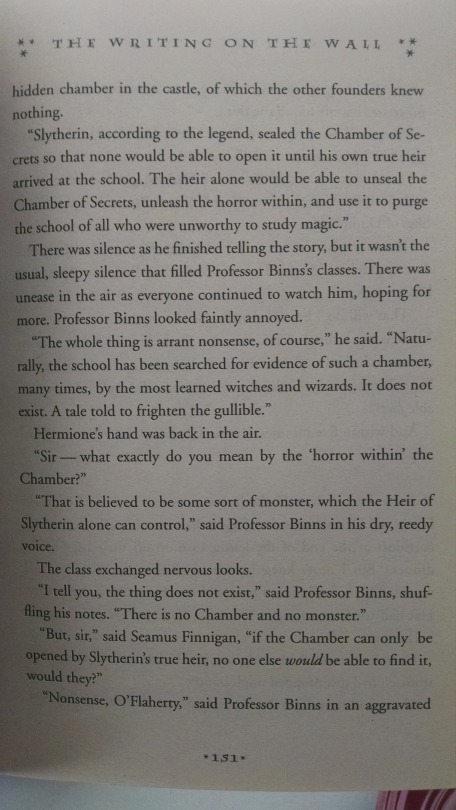
Now, the scene pictured above is one of Harry’s slightly less dull History of Magic classes, in which Professor Binns is asked to talk about the Chamber of Secrets. What we get from him is that the Chamber is a myth. There is legend surrounding it, no one is sure if it exists, etc etc etc.
Here is the VERY NEXT PAGE in the book, in which Professor Binns again admits to the Chamber (as we know it today) to be a complete myth. We find out, obviously, that the chamber isn’t a myth, but I believe that the purpose of the chamber has been fabricated over a thousand years by misinformation and slander.
Let’s check it out. Rowena Ravenclaw, Helga Hufflepuff, and Godric Gryffindor all know Salazar Slytherin and say “yep, he’s an upstanding man. Let’s start this school with him!” For a number of years, they had a school together and it worked out great. What we know is that there was a falling out, not Slytherin declaring they needed to murder muggle-borns! A disagreement that may have ruined friendships but did little else, I think.
What we know is that one of Slytherin house’s key virtues is self-preservation. As I discussed earlier in the thread on this post is that Slytherin was afraid of muggle-born witches and wizards acting as spies for the larger muggle community during a time in which wizards and witches were killed for their “demon powers.”
And so, when it comes to the Chamber of Secrets, I believe Slytherin built a Panic Room, not an Evil Lair.
Think about it. Slytherin is horrified that any day there might be an attack on the school. So he builds a secret chamber that only he (or another parseltongue, an incredibly rare magical ability) can open. He doesn’t want any double agents or spies to know about it, so he tells no one. He hopes, of course, that he never has to use it, but in the event that there is an attack, he can get the school to safety while he sets the basilisk on the attackers.
But I’m sure you’re looking at the basilisk and thinking “what sane man would put a monster in a panic room?” Glad you asked. I can consider two possibilities.
1) Slytherin put a basilisk that was under his control in the chamber, a creature that he could set loose on his enemies, aka, anyone attacking the castle. The basilisk would annihilate any army of thousands just by looking at them, and what’s more, it could get almost anywhere in the castle through the goddamn walls! That kind of power is exactly what you need to defend your castle. And again, ONLY HE or an heir could control it. I’m sure at this point he was thinking about himself and his potential progeny, not Tom Riddle some thousand years later.
2) Slytherin didn’t put the basilisk there, and it was instead placed there later by Tom Riddle while he was at school. I don’t have evidence supporting or disproving this.
So how does this get so misconstrued to modern-day Hogwarts lore? Maybe toward the end, the founders did find out about the Chamber. Maybe Slytherin said something to them, maybe he let it slip…maybe as they were cleaning out his room after he left, they found some journal entries about it. It could have been anything. But perhaps, in their wisdom, seeing no way to access the chamber, felt it best that no one knew about the existence of a (now) useless panic room, nor did they want anyone to worry about the basilisk.
Maybe word *did* get out, though. And not one of the founders wanted to admit that Slytherin didn’t trust their students, and so to most of the student body, Slytherin’s departure was suspect. And the moment they heard about a secret room that no one was quite sure about, they started inventing campfire stories about it.
Fast forward ONE THOUSAND YEARS and now everyone assumes Slytherin was always evil (despite being a good friend and founder of Hogwarts with three other lovely people) and created a secret evil lair to murder muggle-borns, which he could have easily done without a lair if that was *ever* his intention.
Okay. We’re going to do this now because I will probably not
rest at ease until I’ve corrected the unholy mess that is this post. It’s long, I get angry, I’m sorry. So here
goes:
1) A bigot is a bigot is a bigot.
If a person is using the language of “threat”
and “risk” to deny children – ELEVEN YEAR OLDS – an education because
of the apparent risk they pose to adults in the community, then yes, they are a
bigot. It’s no different from white parents being antsy because there’s one
muslim kid in their child’s class. It’s the same principle.
2) The witch
hunts did not start in earnest till the 15th century.
Please; even Wikipedia has extensively sourced material on how the witch
hunts really only started in the fifteenth century, in the Early Modern period
in Europe. The general entry on Witch-hunts (and I mean come on, all this shite is right here on Wikipedia for
you to read for yourselves, rather than relying on some ludicrously idea of
what the medieval period was like) on Wikipedia has this under its medieval
period section:
Early secular laws against witchcraft include those
promulgated by King Athelstan (924–939 AD):
“And we have ordained respecting witch-crafts, and
lybacs [read lyblac “sorcery”], and morthdaeds [“murder, mortal
sin”]: if any one should be thereby killed, and he could not deny it, that
he be liable in his life. But if he will deny it, and at threefold ordeal shall
be guilty; that he be 120 days in prison: and after that let kindred take him
out, and give to the king 120 shillings, and pay the wer to his kindred, and
enter into borh for him, that he evermore desist from the like.”
“We have decided, regarding witchcrafts, sorcery, and
murder, if anyone should thus be killed and it cannot be denied, they must pay
with their life. However, if they deny it, and at a threehold ordeal (three
innocence-tests e.g. drowning, fire, blessed-cake) be proven guilty they must
pay for it with 120 days in prison, and
their family must, after this time, pay to the king/government/tax collector 120
shillings, and the individual must pay wereguild (blood-reparation) to the kin
of the deceased and enter into a pledge with them that he evermore desists from
doing so again” (shoutout to essayofthoughts for converting the language)
Which in sum follows a pretty common cultural rule
concerning magic in all cultures, throughout the ages – you hurt someone
and it is “proved” that this hurt is the result of witchcraft, then you pay for
it. I think it’s a fairly reasonable kind of statement to make, given that it’s
not all that different from our laws against murder. I’m not sure why “magic”,
especially in the context of HPverse where magic does exist, is supposed to somehow preserve people from bearing the
weight of any crimes exerted against non-magic neighbours… And given the way
wix treat muggles in the books – obliviating them at will (hello yes, Goblet of
Fire World Cup anyone?) down to torturing them for sport (also, Goblet of Fire
World Cup when the Death Eaters make an appearance) and someone once proposing
to make muggle-hunting legal – it’s not an unreasonable sort of fear to have
imo.
(Keep in mind here, witches and wizards do have power that muggles don’t have access to and this, even though wix are a “minority” community does place wix higher on the power scale
than muggles. Muggles can retaliate only with weapons against a force which
they know nothing about. Think about
it. You’re living in a community with a bunch of people who have a kind of
power you don’t know the extent of, besides that they can kill without even
touching you, and you have to trust them to be good to you, even if they think
you’re dirt and inferior to them. So yeah, this is a case where I’d argue that
a minority community actually has more power than the majority community especially in the context of the medieval period. Unless you want to argue that all minority communities ever are persecuted,
in which case CONGRATULATIONS! Rich people who control the vast majority of the
world’s resources are now a persecuted minority!)
If you want more scholarly resources on the witch hunts,
there’s Kors & Peter’s Witchcraft in Europe, 400 – 1700: A Documentary
History, J B Russell’s Witchcraft in the
Middle Ages and Dissent &Order in the Middle Ages: The Search For
Legitimate Authority, this paper on the Medieval Origins of the Witch Hunts
from Cambridge Quarterly, this
sociology paper on the European witch hunt craze of the 14th -17th century from
the American Journal of Sociology and
this paper from The Journal of
Interdisciplinary History on the Historiography of the European Witchcraft.
This isn’t even like, 1/100th of the sources out there on the origins of the
witch-hunts/a survey of the scholarship on the matter. The consensus of all of them is that the witch hunts didn’t begin
in earnest till the 15th century, though there might have been persecutions
here and there. In fact till the 14th century, belief in the very idea of
witchcraft and that witches had the powers to do what some people claimed they
did was banned. To believe in the possibility of someone practicing witchcraft
was as much of a heresy as to practice witchcraft. It wasn’t until the 14th
century that the Inquisitions were authorized to prosecute for witchcraft and
even then it seems to have only been investigated incidentally during
investigations for heterodoxy.
TL;DR: You were more likely to get hauled up for heretical
beliefs and getting your theology wrong than you were for practicing witchcraft
in the medieval period.
3) The destruction of
texts on magic =/= persecution on the basis of witchcraft.
The post mentions that a lot of the texts dealing with
native magic practices were destroyed during the spread of Christianity through
Europe and while that’s certainly true of Norse magic (I know, because trying
to find non-apocryphal information on historical practices of Seidr is impossibly hard) I don’t think it
necessarily holds true across all of Europe, or hell, Britain. There’s a fair
bit of Irish and Welsh lore which survived, as well as Roman records on the
magical practice (how much of it is true, we don’t know, but given that the
druids themselves passed their lore down mostly verbally this kind of is a moot
point imo) and a decent chunk of folklore magic survived and passed down quite
intact…
There’s a few points worth making here:
A lot of texts were being destroyed and counter-destroyed
as parts of various agendas during the medieval and early modern period. But I
don’t think that it necessarily means that all secular texts were destroyed and abandoned during this period. Iirc, Latin
was introduced into the noble man’s curriculum via both the Bible as well as the Justinian Laws and the
Latin classics – similarly so with Greek. Sure, not everyone could go to
University to be educated, but these texts were definitely being studied at the
Universities of the times and given that the Arthurania (and its various
variations) became popular again in the 14th century or so, along
with the rise of the codes of chivalry, and that the Canterbury Tales are definitely
a thing which existed; it’s safe to say that the medieval period wasn’t just a bunch of people who suffered from
some kind of religious mania and never read/wrote anything else ever. That’s how they’ve been construed in our popular
imagination but it’s not necessarily an accurate image.
Given that in the course of my own research on
necromancy during the medieval period (because I needed information for fic
purposes, of course) I found several medieval codexes scanned on to online archives on how to summon demons
and other necromantic practices, I think it’s safe to say that not even writing
on magic was entirely stamped out or completely destroyed irl, let alone in HPverse.
A lot of folklore on magic & mythology was
incorporated into the church “lore” and survived albeit in syncretic form. I
think that’s true of most things tbh, I don’t think you can for a minute
pretend that any kind of belief/culture/cultural practice which exists today
exists in precisely the same form as it has always existed since the founding
of cultures. Cultures and societies are fluid and ever-changing, beliefs are
assimilated and discarded. In this case, a fair bit of folklore made its way
into shaping how the “commoners” practiced the formally introduced religion.
Honestly all you have to do is watch a few episodes of Horrible Histories to
figure this out on your own.
4) JKR on Salazar Slytherin
and Pureblood Mania:
Now that we’ve debunked the history parts of this post, let’s
move on to what JKR herself has written at various point in her books and Pottermore,
about the matter of witch hunts and pureblood mania.
In the Pottermore article on Purebloods and to some extent,
the article on the Malfoys, we’re explicitly told that prejudice against
muggleborns and muggles rose drastically after the institution of the Statute
of Secrecy (pretty much expected given that places most likely to vote in
favour of fascist & anti-immigration parties are also the places least in
contact with people from other races, ethnicities & cultures) and the idea that
muggleborns posed a threat because of the Statute only really came into its own
there. I think I’ll let JKR’s own writing
do the talking here.
Historically, the Malfoys drew a sharp distinction between
poor Muggles and those with wealth and authority. Until the imposition of the
Statute of Secrecy in 1692, the Malfoy family was active within high-born
Muggle circles, and it is said that their fervent opposition to the imposition
of the Statute was due, in part, to the fact that they would have to withdraw
from this enjoyable sphere of social life. Though hotly denied by subsequent
generations, there is ample evidence to suggest that the first Lucius Malfoy
was an unsuccessful aspirant to the hand of Elizabeth I, and some wizarding
historians allege that the Queen’s subsequent opposition to marriage was due to
a jinx placed upon her by the thwarted Malfoy.
With that healthy degree of self-preservation that has
characterised most of their actions over the centuries, once the Statute of
Secrecy had passed into law the Malfoys ceased fraternising with Muggles,
however well-born, and accepted that further opposition and protests could only
distance them from the new heart of power: the newly created Ministry of Magic.
They performed an abrupt volte-face, and became as vocally supportive of the
Statute as any of those who had championed it from the beginning, hastening to
deny that they had ever been on speaking (or marrying) terms with Muggles.
Magical opinion underwent something of a shift after the
International Statute of Secrecy became effective in 1692, when the magical
community went into voluntary hiding following persecution by Muggles. This was
a traumatic time for witches and wizards, and marriages with Muggles dropped to
their lowest level ever known, mainly because of fears that intermarriage would
lead inevitably to discovery, and, consequently, to a serious infraction of
wizarding law.
Under such conditions of uncertainty, fear and resentment,
the pure-blood doctrine began to gain followers. As a general rule, those who
adopted it were also those who had most strenuously opposed the International
Statute of Secrecy, advocating instead outright war on the Muggles. Increasing
numbers of wizards now preached that marriage with a Muggle did not merely risk
a possible breach of the new Statute, but that it was shameful, unnatural and
would lead to ‘contamination’ of magical blood.
As Muggle/wizard marriage had been common for centuries,
those now self-describing as pure-bloods were unlikely to have any higher
proportion of wizarding ancestors than those who did not. To call oneself a
pure-blood was more accurately a declaration of political or social intent (‘I
will not marry a Muggle and I consider Muggle/wizard marriage reprehensible’)
than a statement of biological fact.
JKR furthermore completely debunks the idea that muggleborns
were viewed with anything approaching suspicion during the 10th
century with this statement from the entry on Purebloods on Pottermore:
Slytherin’s discrimination on the basis of parentage was
considered an unusual and misguided view by the majority of wizards at the
time. Contemporary literature suggests that Muggle-borns were not only
accepted, but often considered to be particularly gifted. They went by the
affectionate name of ‘Magbobs’ (there has been much debate about the origin of
the term, but it seems most likely to be that in such a case, magic ‘bobbed up’
out of nowhere).
So let’s be very clear here. Slytherin’s views were
considered outliers at the time which certainly suggests that muggles were not
thought of as posing anything approaching a significant threat to the magical
community at all – which I think my write-up on the history of the witch-hunts + JKR’s own writing on the witch hunts amply explains. Muggleborns were considered unusually gifted because of their
ability to perform magic instead, so it’s more likely that Hufflepuff,
Ravenclaw and Gryffindor represented the mainstream views of their time and
weren’t necessarily fighting for some kind of airy ideology of
bravery/acceptance/collecting knowledge that they’d attached themselves to.
Speaking of which JKR is pretty damn clear that the founders
quarrelled over Slytherin’s views on muggleborns. Like, it’s not subtext or
in-text propaganda. JKR’s outright written it as part of HPverse history.
Where Slytherin’s views gain traction is after the institution of the Statute of
Secrecy following what I think was a particularly bad spate of persecution at
the hands of James II – under whom the witch hunt craze reached its zenith.
William of Orange took over in 1688, but I’m guessing that by then the damage
had been done to the wizarding community and presumably also, William would have
had other struggles in consolidating his power before he could get to dealing
with the witch hunt business. It’s under this condition of fear and resentment followed by separation from the muggles that
the ideology of pureblood supremacy really comes into its own and muggles go
from being just odd and harmless weirdoes into the image of a villainous and dangerous Other. This is in 1692. That’s nearly 700 years after the founding of Hogwarts. That’s when
muggles really started to be viewed as a threat to the wizarding world. Not
during the early medieval period. Not even under the rule of Queen Elizabeth
the First. In 1692 during the reign of William of Orange.
In the essay Harry mentions Wendelin the Weird, who actually
enjoyed being burnt at the stake so much, she allowed herself to be captured in
disguise forty-seven times and
escaped each time using flame-freezing
charms. The Fat Friar was executed because church members grew suspicious of
his ability to cure the plague by poking people with a stick and because he pulled rabbits out of a wine cup so it’s
not exactly like the dude was exercising caution over here or even trying to be
circumspect. Nearly Headless Nick enjoyed what seemed to have been a
pleasant life until he somehow cocked up fixing Lady Grieve’s (lady-in-waiting
to Henry VII) teeth and made her grow a tusk (like holy shitballs how bad do you have to be at magic to do that)
instead, after which he was imprisoned and executed the next morning in an
obvious parody of Tudor justice.
(The Tudors were a whimsical bunch to live under.)
There’s a few lessons/inferences we can make here:
The probability that actual wix were affected by
the witch-hunts is probably much less than we imagine they are or indeed, the
magical community imagines they are. Wix had a whole variety of charms to keep
their neighbours from ever really getting on to them – muggle repelling charms,
which we know is a thing given that Hogwarts was concealed by them all the way
back in the 10th century (besides being Unplottable and therefore, not-findable by wizards as well, so please don’t trot out their muggle repelling charms as
incontrovertible proof that they were afraid of muggle persecution; in all
likelihood they wanted to keep the castle out of any conflicts and to keep the
children in an environment where they could safely practice their magic without
accidentally hurting some random wanderers), anti-flame freezing charms to save
them from being burnt, Obliviates to make sure your neighbour never remembers
what happened to them and so on and so forth. You would probably have to have
been really daft (Sir Nick) or really obvious and careless (the Fat Friar) or
some kind of weirdo (Wendelin) to get caught for actually doing magic on
muggles. I mean ffs, the magical world can cover up a huge war during the
seventies in Britain where muggles are being killed in addition to magical folk
and you want to talk about how they were terrified of exposing the Statute?
Hon, that’s your answer right there.
The community probably most at risk for being
persecuted for magic is DING DING DING YOU GUESSED IT: MUGGLEBORNS. Guess why?
Because the kids actually live with muggles and are less able to control their
magic in their childhood and are actually at risk of exposing their magic (and
probably putting their families in danger from society) to people at large. notyourexrotic expresses this much better over here in this post. Hogwarts
would have been protection for these people, but no, what we’re doing here is
what literally every anti-immigration politician fuck has done in the past few
years and talked about how muggleborns would pose a “threat” to the stability
of magical society because of the risk they posed in exposing their society to
the muggle world. Yeah, maybe if you gave
them the support they needed they wouldn’t be at risk of doing so.
Leading off from this, it’s also likely that a
high proportion of muggles were impacted by this as well, especially if they
had muggleborn kids.
Where I imagine the witch hunts really would
have an impact on pureblood wix/wix communities proper is when whole villages were
being investigated for witchcraft which honestly was something which only
really started happening in the 16th-17th century
(especially under James II).
Also spies, really? An eleven year old is going
to want to be a spy on people who do magic because??? ????? ????????? I can
think of scenarios where a seventeen year old might agree to do something like
that but the only scenario where I can imagine such a thing happening is
when the seventeen year old has been isolated and injured and hurt by magical
society enough that they think it’s worth betraying them to find some kind of
home for themselves among a society which has promised to reward it, in this
case, muggle society. Like. In which case, the people clearly at fault here would be MAGICAL
SOCIETY. For injuring a muggleborn on the principle that they were a
muggleborn.
Salazar Slytherin has nothing to stand on concerning his prejudice. Nothing to legitimate it at all.
6) Cuthbert Binns.
Now that we’ve covered the historical accuracy of witch
hunts, who they would have been most
likely to have affected and how this fear of muggles is directly connected to
the institution of the Statute of Secrecy, I think it’s safe to say that we can
make this inference about wizarding history: it’s not objective.
I mean, history in general is not objective. What you have is multiple perspectives about a
series of events. In this instance, we get Cuthbert Binns’ version of history
which as we’ve seen over here, has little to no basis in history – either in
real life, or in the context of HPverse. We know that the curriculum at
Hogwarts is overseen by the Board of Governors, who consist of men like Lucius
Malfoy, as well as the Ministry of Magic – which happens to be in the pockets of
men like Lucius Malfoy. We also know that Cuthbert Binns has been around for a
long long time, so it’s safe to say that he hasn’t really acquired any new
perspectives on history or on muggles or muggle-wizard history/relationships
for a long long time.
In which case, it all begs the question: just how accurate
is Binns’ narrative of witch burnings? Is he simply reproducing a version of
history which has been produced and reproduced over and over again since the
institution of the Statute of Secrecy, to justify the actions of wix and moreover, to justify their hatred of muggles?
Is he a reliable narrator here, or is JKR employing an unreliable narrator to
tell us how wizards think of their history – supplying ample information on the
side to show us just how imbued with propaganda and pureblood ideology this
version of history is?
I think that this is very
much what JKR is doing here and to pretend otherwise is disingenuous. If
Cuthbert Binns is a reliable mouthpiece, then so too is Severus Snape, Barty
Crouch as Mad Eye, Dolores Umbridge, Gilderoy Lockhart, Quirinius Quirrell –
any teacher, for that matter, at Hogwarts. But I think the books spent enough time
showing us just why this is not so for
us to not fall into the same trap here!
7) The Chamber of
Secrets.
A few things. JKR has told
us explicitly that Salazar put a basilisk in there. JKR has also told us
explicitly on Pottermore and in the books as well, that Slytherin and the
others quarrelled over the matter of letting in students of different blood
purity. We’ve also seen JKR’s own writing on the prevalent views on Muggleborns
at the time, so it’s clear that Slytherin was a statistical outlier.
Look at the structure of the Chamber of Secrets and tell me
what about it suggests that it is a “panic” room. Here are quotes from Chapter 17, Slytherin’s Heir, from The Chamber of Secrets:
And then, at last, as he crept around yet another bend, he
saw a solid wall ahead on which two entwined serpents were carved, their eyes
set with great, glinting emeralds.
He was standing at the end of a very long, dimly lit
chamber. Towering stone pillars entwined with more carved serpents rose to
support a ceiling lost in darkness, casting long,black shadows through the odd,
greenish gloom that filled the place.
He pulled out his wand and moved forward between the
serpentine columns. Every careful footstep echoed loudly off the shadowy walls.
He kept his eyes narrowed, ready to clamp them shut at the smallest sign of
movement. The hollow eye sockets of the stone snakes seemed to be following
him. More than once, with a jolt of the stomach, he thought he saw one stir.
Then, as he drew level with the last pair of pillars, a
statue high as the Chamber itself loomed into view, standing against the back
wall.
Harry had to crane his neck to look up into the giant face
above: It was ancient and monkeyish, with a long, thin beard that fell almost to
the bottom of the wizard’s sweeping stone robes, where two enormous gray feet
stood on the smooth Chamber floor.
… watched Riddle stop between the high pillars and look up
into the stone face of Slytherin, high above him in the half-darkness. Riddle
opened his mouth wide and hissed — but Harry understood what he was saying…
. “Speak to me, Slytherin, greatest of the Hogwarts Four.”
Harry wheeled around to look up at the statue, Fawkes
swaying on his shoulder. Slytherin’s gigantic stone face was moving. Horrorstruck, Harry saw his mouth opening,
wider and wider, to make a huge black hole. And something was stirring inside
the statue’s mouth. Something was slithering up from its depths.
Something huge hit the stone floor of the Chamber. Harry
felt it shudder — he knew what was happening, he could sense it, could almost
see the giant serpent uncoiling itself from Slytherin’s mouth.
Everything about the structure, from the snakes twined
around the pillars and the doors with emeralds,
mind you, in the snakes eyes, to the giant statute of Salazar Slytherin,
suggests less place to retreat to in time of emergency and more “shrine to
Salzar Slytherin”.
The Chamber of Secrets itself is such an interesting room
because like. If ever there was a room as steeped in pure ideology, it’s the
chamber? The whole structure revolves around Salazar Slytherin; it’s a
self-glorificatory room and tbh that’s always what I’ve wondered a little about
Slytherin and its obsession with blood purity – if it was not a kind of
narcissistic self-worship that became reified into this idea that blood really
was the source of magical power and virtue in the wizarding world. The
flip side to murdering people for their supposed inferiority is the
glorification of the self – which is something you see a lot in fascist art and
propaganda; all based around either a single glorious figure, or an idealized
figure that people are meant to aspire to. I think that’s very much something
that’s going on in the Chamber of Secrets and the entrance being situated in
the girl’s toilet is something which amused me no end because again, JKR
strikes with a visual pun, but also again we get the “submerged in ideology”
image, because descending down this path gives you people willing to murder children for
being ‘inferior’ and having the wrong kind of blood and posing a ‘threat’ to the
superiority of pureblood society.
… the Chamber of Secrets is pure fascist ideology embodied,
it is not a panic room. Everything about its architecture is
reminiscent of the kind of architecture you’d get in a totalitarian fascist
state and it has a fucking living declaration of war and genocide (the
basilisk) living inside it, put over there by the man who created the room.
I think the description of the room speaks for itself and
the fact that JKR has independently confirmed that Slytherin did put the basilisk in there, it’s safe
to assume that Slytherin also set the code that would make his statue release
the basilisk from within its depths – which imo, I think is pretty telling
about the kind of person Salazar Slytherin was. I don’t think he really cared
about the wizarding world at all, I think he care more for his idea of it and for him, it was important
to preserve that idea and that ideal which he had conceived of – a typical
tenet of fascist ideology – and to do so, he actually hid a goddamn weapon of war inside a school full of children
with the intent that some day one of his heirs would continue his genocide on
his behalf.
WHICH BRINGS ME TO MY LAST POINT
8) All of this
reminds me disturbingly of the kind of rhetoric used to defend fascists,
racists and people who have committed genocide and large scale ethnic
cleansings.
Sure, Salazar could have killed muggleborns in any number of
different ways if he wanted to. But the thing about ethnic cleansings and
genocides is that the violence is rarely clinical or efficient. There is a huge symbolic element to violence. Arjun Appadurai more or less expresses this
idea in his paper Dead Certainty: Ethnic Violence in the Era of
Globalization. The gist of his analysis, based on the ethnic cleansing of
Tutsis during the Rwandan Genocide of 1995, states that the violence enacted on
the bodies of those being killed was never just about killing them, but was performed in such a way as to symbolize their “different-ness”
from Hutu bodies – even though it is nearly impossible to distinguish between
who is and who isn’t. The form of violence enacted on their bodies serves as a
marker and a distinguisher. I think it’s a point worth bringing into the
discussion here because it’s exactly what
Bellatrix does when she carves the word mudblood into Hermione’s arm. There is
no difference, magically, between her and Hermione – carving that word there
makes all the difference.
I just want this quote here to illustrate why this kind of violence
is never satisfying and why it continues and moreover, why it continues to justify itself as “rational” and “acceptable”:
“Of course the violent epistemology of bodily violence, the
`theatre of the body’ on which this violence is performed, is never truly
cathartic, satisfying, or terminal. It only leads to a deepening of social
wounds, an epidemic of shame, a collusion of silence, and a violent need for
forgetting. All these [acts] add fresh underground fuel for new episodes of
violence. This is also partly a matter of the pre-emptive quality of such
violence: let me kill you before you kill me. Uncertainty about identification
and violence can lead to actions, reactions, complicities, and anticipations
that multiply the pre-existing uncertainty about labels. Together, these forms
of uncertainty call for the worst kind of certainty: dead certainty.”
Everything about the Chamber of Secrets and the basilisk
being placed there to kill muggleborns is symbolic. Salazar is the one who
cares about protecting blood purity, it is his face that the wizarding world must look to when the time comes to rid
themselves of “the threat within”. He chooses a serpent to symbolize himself –
and tbh, if I wanted to there’s probably a whole level of Freudian analysis we
can make here, but lbr, the Chamber of Secrets is pretty much a kind of
hypermasculine fantasy without even getting into talking about how Salazar
chooses a snake; a symbol not only of
cunning, but of fertility, luck and protection – and to enact violence upon
muggleborns & muggles. It’s almost too obvious in its symbolism, but here we are with a very clear message being sent out:
that muggles and muggleborns do not deserve protection, they are not the kind of population that is to be
protected and they will be murdered by this symbol of all of these things
because they are less than human and the “evil within”.
Speaking of which, so much of the rhetoric in this post
focuses around muggleborns as the “evil within” or the “threat within”. I’m
genuinely curious here, does no one see the parallels between this kind of
language and the language used to justify the persecution of immigrants,
minorities and for fuck’s sake, used to justify the Holocaust? I think tumblr
user brotheralyosha puts it best here in this reblog of a post I made:
The idea that “foreigners” in a community are really spies
for outside powers who might destroy the community from the inside, and that
therefore need to be kept separate and defended against, is a fundamental
ideological component of fascism and white supremacy.
Here’s a poster, by the way, from the films which more or
less centre around the whole crux of this post – muggleborns posing a threat to
wizarding society from inside. It’s Death Eater propaganda, for the record:
The reason I’ve sat down to write a 5k word rant about this
post, with links to sources and stuff, is because I am genuinely disturbed that these are things we can say and endorse
unironically in fandom because they form
the crux of real world ideologies that have been used to murder people on the
basis of race, religion, ethnicity and sexuality. This is exactly the kind of defence that has
been used to bolster their arguments.
You know what I find invariably when people mention a “threat”
to their societies?
It’s the powerful majority speaking about a
minority they have been made aware of, which pose a threat to the social norms
and structures they have imposed on themselves to govern their lives.
There is almost never any actual threat, beyond a hysterically exaggerated one –
remember what I said earlier about the places most willing to vote in right
wing fascists being the ones with the least diverse populations, repeat that
again over and over again to yourself – which focuses on the idea of a “pure”
society which must be preserved. Societies are not pure, cultures are not pure;
they have always been syncretic, they have always been changing, they have
always been fluid and dynamic and anyone who tells you otherwise is
lying.
I’m sorry but J K Rowling did not write seven books of what amounts to a war against
this kind of ideological defence – Salzar Slytherin actually had the right
idea, he was the only founder who cared about the wizarding world but history
pilloried him as “paranoid” and “evil” because he chose to take “precautions”
against the “danger within” (honestly, do you think there aren’t actual
Nazis and Neo-Nazis and Anti-Semitists and racists and fascists who are spouting
this shit in defence of Hitler right now? Let me tell you, there
probably are!) – to have fandom spout it back in defence of a character
in the name of redeeming Slytherin house from its tarnished and “false” image
in the books. She deconstructed the whole mythos of muggleborns being a threat,
both historically and in the present day to show just how wrong Salazar Slytherin, Voldemort and the Death Eaters were in their beliefs. Congratulations!
You have missed a crucial point of the Harry Potter books in favour of
redeeming a character because you want to give kids who are sorted into
Slytherin “representation”.
Redeem Slytherin house as much
as you want. But don’t you dare use the defensive language of racists,
fascists and neo-nazis in your posts in an effort to “redeem” a character in a
bid for whatever twisted-ass idea of “representation” you’ve conjured up for
kids who are scared of being sorted into Slytherin on Pottermore. There is a
line and that line has been fucking crossed here and I am furious, but even
more I am frightened because this is the
sort of language that has been employed to tell me, an Indian immigrant living
abroad, that I am a threat to all that is good and noble about UK society and here we are, with fandom using it unironically in
defence of a character that JKR left no
ambiguity whatsoever over concerning their bigotry.
Please please be critical of the ways in which you choose to headcanon and defend characters who are clearly portrayed as bigots in the text!
It’s shit like this which makes me want to leave fandom.
You know we’re in the dark timeline when Stephenie Meyer has minded her own damned business for years and J.K. Rowling keeps tumbling down the metaphorical steps of murdering her own universe and personal character in the public eye for everyone to see.
Like, if in 2008 you had told me Stephenie Meyer would quietly retire and stay in her lane instead of continuing to write weird Mormon fantasy with nothing but white characters and J.K. Rowling would be on Twitter spouting some shit like “THE GOBLET OF FIRE WAS ACTUALLY ONCE A TRANS WOMAN, I’VE BEEN SITTING ON THIS SINCE 1986!” I’d say you were a fucking liar.
But here we are.
Reblogging for both the commentary and the blog name.
Okay you can say what you want about the Twilight Saga but one of the main characters and several of the secondary characters were Native American (and played by actual Native people in the movies!) so like, in no way were all of the characters white
Yeah but that’s kind of negated by the fact that a lot of the people belonging to the Native American group she wrote into her book (the Quileute) hated the way they were portrayed and the fact that her explanation for their Lycanthropy was actively offensive.
Also, Taylor Lautner’s Native heritage is apparently distant and he didn’t know about it until after he was cast, so they were absolutely cool with hiring someone who was not Native for the most prominent Native role.
And Stephenie Meyer has had three books come out since 2015, one of which was a Twilight gender flip and is apparently just as bad.
You may have heard about the efforts in Europe to reform copyright law. The debate has been ongoing in the European Parliament for months. If approved next week, these new regulations would require us to automatically filter and block content that you upload without meaningful consideration of your right to free expression.
We respect the copyrights and trademarks of others, and we take all reports seriously to ensure that your creative expression is protected. We make this clear in our Community Guidelines. There’s already a legal framework that works and is fair: Todaywe take down posts and media that contain allegedly infringing content when we receive a valid DMCA (Digital Millennium Copyright Act) takedown request. We also provide clear-cut ways for people to fight back if they believe their removed content was not a true violation. These instances are monitored and reported and live in our biannual transparency report.
The suggestion to use automated filters for issues of copyright is short-sighted at best and harmful at worst. Automated filters are unable to determine whether a use should be considered “fair use” under the law and are unable to determine whether a use is authorized by a license agreement. They are unable to distinguish legitimate parody, satire, or even your own personal pictures that could be matched with similar photographs that have been protected by someone else. We don’t believe that technology should replace human judgment.
Tumblr is and always has been a place for creative expression, and these new regulations would only make it harder for you to express yourself with the freedom and clarity you do so now.
If you access Tumblr from Europe and want to act, you can find more information on saveyourinternet.eu.
Please reblog this as much as you reblogged the posts about Net Neutrality.
If Article 13 is approved, European People might be basically banned from uploading any fan content.
You won’t get new fanfics from people in Europe.
You won’t get new gifs from people in Europe.
You won’t get new fanart from people in Europe.
Because they’ll be automatically filtered and blocked!
We might leave Tumblr and other fandom pages.
And if we’re getting all our content blocked?
You might lose some of your favourite followers/mutuals.
You might not get to read the rest of that fic you’re dying to read – simply because the writer lives in the wrong country.
So do whatever you can to help us stop this.
Reblog this.
CONTACT YOUR REPRESENTATIVES TO TELL THEM YOU DON’T WANT ARTICLE 13 TO BE APPROVED IF YOU’RE EUROPEAN! DO IT VIA THE HOMEPAGE
SIGNAL BOOST PLEASE
THIS IS IMPORTANT AGAIN
Reblog friends!!!
reblogging again because our govern is shit please help us
A lot of the responses to my very popular YA lit post (the “Super Special White Girl and Her Mysterious Brooding Boyfriend” one) have been stuff like, “There’s so much diversity in YA!!! Don’t throw the genre under the bus!!!”
And I’m very frustrated for a few reasons because the point of my post wasn’t that there’s no diversity in YA.
My point was that first of all, for all the diversity in YA, last I checked it’s still the white cishet sometimes-vaguely-Christian kids that get the most stories. I recall reading somewhere–and I wish I had the source but I’m on mobile–that according to a survey taken in (I want to say) 2012/2013/maybe 2014, stories about white kids far outweigh stories about POC kids, stories about boys outweigh stories about girls, etc etc. So yeah, there’s definitely diversity, but we’re still getting a lot of one type of story.
Second of all, a LOT of those stories have bad visibility. Like, they seem to be very well-known based on people talking about them online, but most of them don’t get hyped up in the mainstream.
And the “diverse” YA novels that DO get a lot of mainstream recognition seem to always be the “typical” stories, the oppression narratives–stories about black kids overcoming poverty and racism, gay kids being bullied, trans kids “born in the wrong body,” etc etc. Those stories are important and have their place, but goddamn, when are we getting a movie adaptation of the book about the black lesbian trans girl who’s the chosen one and goes on an adventure in a magical land?? And even when we do have a “diverse” YA story that gets very popular, there’s always the real risk that Hollywood ends up whitewashing them–see The Hunger Games for Exhibit A.
And then of course there’s people whining about how adult fiction isn’t any better, and honestly I shouldn’t even acknowledge that because I’m not stupid. I know adult fiction suffers from the same problems. I’m not putting YA down and I’m not saying any other genre is better. Criticizing the problems in one genre isn’t the same thing as bashing it and it doesn’t mean I’m ignoring the issues in other genres.
We don’t need to go searching too hard to find stories about cishet white kids having deep complex thrilling adventures because there’s an overwhelming amount of those stories and they have a staggering amount of visibility. Go into any Barnes and Noble YA section and look at some of the covers. Read a couple of the back covers and dust jackets and tell me it doesn’t start to blend together after a while.
Judging from the responses to my post, a lot of people don’t even know about how much diversity there already is in YA. A lot of people were saying they were ready to give up on the genre because everything that gets popular and reaches the mainstream tends to either be stories about cishet white kids, or tired reformulations of the same old LGBT/POC/etc oppression narratives.
Overall, my point was primarily about the fact that diversity in YA gets bad visibility and it’s very easy to think that it’s all about Super Special White Girls and their Mysterious Brooding Boyfriends.
So like, maybe consider that before you read a joke post and assume that the book-loving former library employee thinks YA is stupid and therefore doesn’t know what she’s talking about, bye.
All of this is very true, and they are still problems YA has to grapple with, even as we find and boost collections and lists of more diverse YA.




 Blenderbender1811 on wordpress